Posts

Showing posts with the label Summa of the Christian Life

Eucharistic Reflection - A Worthy Communion

Image
(Image Source: Wikimedia Commons ) "The first thing required for a worthy Communion is that one recognize, with great humility, that no human efforts will suffice to make this preparation if God does not assist him. As no one can dispose himself for an increase of grace without grace, so no one can prepare for the reception of God but God. Therefore, one should beg Him with humble and burning desires to cleanse and purify the house where He is going to dwell. To do this as we ought, the first thing required is freedom from mortal sin. The Apostle strongly said that whoever eats the bread or drinks the chalice of the Lord unworthily is guilty of the body and blood of the Lord. In other words, those who approach Communion in the state of mortal sin commits a sin comparable to the sin of those who crucified Christ, because both are sins  against the body and blood of Jesus, although in different ways. Moreover, what can follow from the union of two different things such ...

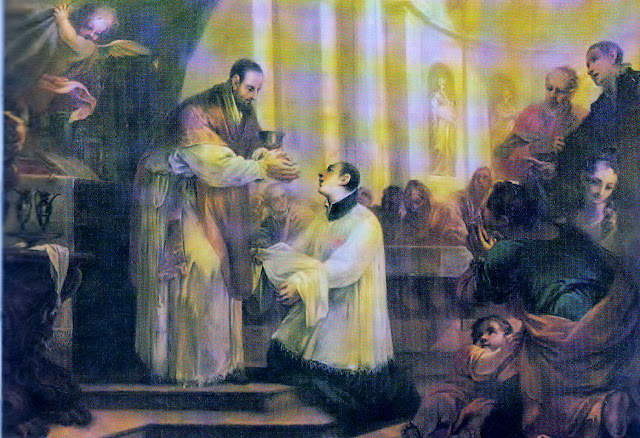
Eucharistic Reflection - The Reverence Our Lord Deserves

Image
"After having received the Sacred Host, one should hold it for a moment in the mouth until it is sufficiently damp and can be swallowed more easily. If this is not done, the host may cling to the roof of the mouth and the person is so busy trying to get it loose and swallow it that he has no attention to give to prayer. (Image Source: Wikimedia Commons ) And one should remain for some time in church, giving thanks to God and speaking to Him who is present in one's breast. Under no circumstances should we, immediately after receiving Communion, congregate with others and spend the time laughing and conversing. This is reprehensible indeed. What bad manners it would be to receive a guest into one's house and then immediately turn your back on him to talk and laugh with others. Cajetan says that this Sacrament communicates grace to the soul not only at the moment it is received, but as long as the sacred species remain in the body. All the more reason why a man...

Eucharistic Reflection - Don't Abstain From This Medicine

Image
(Image Resource: Wikimedia Commons ) “In this Sacrament [Holy Communion] past sins are forgiven, strength is given against temptations, the passions are quelled, temptations are lessened, true devotion is stimulated, faith is strengthened, hope is confirmed, weakness is made strength, charity is inflamed, and the recipient is made a sharer in the merits of Christ and given a pledge of everlasting life.  This is the Bread that strengthens the heart of a man, sustains the traveler, raises the fallen, strengthens the weak, arms the strong, gladdens the sorrowful, arouses the lukewarm, awakens the slothful, cures the sick, and is the common remedy for all needs. It is all things to all men and no one, however unworthy he feels, should abstain from this medicine if he wishes to be cured.” (Ven. Louis of Granada, O.P. from Summa of the Christian Life )

Eucharistic Reflection - It's Called Communion

Image
"[Another] sign of true love is to do good to the beloved and to share with him whatever one possesses, even giving him one’s heart and oneself. True love is never idle, but it always strives to do good for the beloved.                                                               (Image Source: Wikimedia Commons ) But what greater gifts and goods than those which Christ gives us in this Sacrament? In it, we receive the body and blood of Jesus, with all that He merited through that body and blood. We receive Christ and all His merits and sufferings so that we are made sharers in all this through the Sacrament, according to the dispositions with which we receive it. Hence, this Sacrament is called Communion, because through it, God communi...

Eucharistic Reflection - Focus On He Whom You Should Love

Image
“…the principal proof and work of true love is to desire to be united with the beloved. One who loves has all his faculties fixed on the one he loves: intellect, memory, will, imagination, etc. As a result, love is an alienation or ecstasy; it is a self-imposed exile from self, causing a man to be transported to the beloved.  (Image Source: Wikimedia Commons ) Christ manifested this effect of love when He instituted the Eucharist, because one of the reasons for which He instituted it was to incorporate us to Himself and make us one with Himself. That is also why He used the species of food, for as the food we eat becomes part of ourselves, so Christ said: 'He that eats My flesh and drinks My blood, the same abides in Me and I in him’.” (Venerable Louis Granada, O. P. from the Summa of the Christian Life )